Director of Hungarian children's home likely had many more victims than authorities and public were aware of
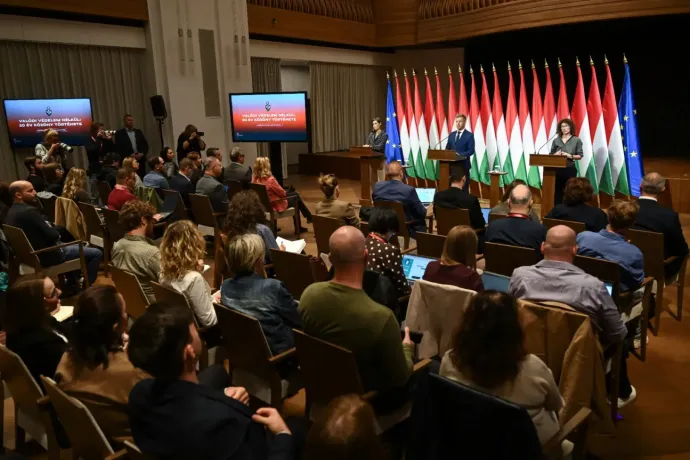


The former children’s home director convicted of molesting children under his care at the children’s home in Bicske may have had many more victims besides those who went public or testified in the proceedings against him, Szilvia Gyurkó, Hungarian State Secretary for Children’s Rights and Child Protection said at a press conference held alongside Prime Minister Péter Magyar on Thursday in Budapest. Gyurkó presented the findings of an investigation into the past twenty years at the Zsuzsa Kossuth Children’s Home in Bicske, which gained notoriety due to the clemency case, which in 2024 led to the resignations of President Katalin Novák, who had granted a presidential pardon to the institution's former deputy director convicted of blackmailing several children to withdraw their testimony against the director, and former Minister of Justice Judit Varga, who had countersigned the clemency.
The investigation covered the period between 2015 and 2025, with interviews conducted with both former and current staff members in addition to reviewing more than 7,000 pages of documents. Gyurkó pointed out that there had never been a comprehensive investigation into the institution before, which made this effort all the more remarkable. They sought to understand how the institution’s interests had taken precedence over the children’s interests and needs.
The State Secretary said that the former director of the Bicske facility was likely dismissed from his previous job in the 1990s due to suspicions of sexual abuse against him even then. There were reports suggesting that he had crossed boundaries with children in Bicske as early as three years after his appointment as head of the institution. Gyurkó emphasized that it is not true that the children did not report that there was a problem with the director and that they did not ask for help.
According to her, it is likely that the director had many more victims than those who came forward publicly or testified in the proceedings against him.
Gyurkó believes that 2010 could have been a turning point in the case as several children came forward to testify about the sexual abuse they had suffered at the director’s hands. However, the police investigation launched in 2011 was eventually closed and the children retracted their statements—which may have been the result of blackmail or bribery. Between 2013 and 2016, the supervising authorities conducted several inspections at the facility, but each of them concluded that everything was as it should be at the children’s home.
Gyurkó announced that the government will establish a one-billion-forint (nearly €2 million 730 thousand) compensation fund for the victims. Resources from the fund will be available to anyone who spent at least one day in a residential child welfare facility or a juvenile detention center after the 1997 Child Protection Act took effect, and who claims that they were subjected to abuse, neglect, or other serious harm during their placement, will be eligible to apply. Victims will also be eligible for legal, psychological, and housing assistance. The fund’s operations will be overseen by an advisory board.
After Szilvia Gyurkó, Prime Minister Péter Magyar took the floor and thanked all those who participated in the investigation for their work. He commended the courage of the young people affected in the case and noted that by speaking out, they had been instrumental in saving many children. He recalled the state honors bestowed upon the director of the Bicske children's home by the Orbán administration and said that a pedophile children's home director would not have been able to run a criminal organization for twenty years without those working around him and officials at the responsible ministry being aware of it.
According to Péter Magyar, former Interior Minister Sándor Pintér (whose ministry was responsible for overseeing the children's homes) and former State Secretary for Social Affairs Attila Fülöp, and ultimately, Viktor Orbán as well bear responsibility for what happened in Bicske.
Péter Magyar promised that in light of the freshly concluded report, the government would introduce specific changes. Among these is that children will be able to submit anonymous reports. There will be unannounced inspections at the institutions, and in serious cases, or those involving senior officials, an independent investigation will be mandatory. They will also initiate setting up a mobile investigation team staffed by specially trained professionals. Magyar said that for him, Bicske represents a standard for measuring “whether the Hungarian state is capable of standing by children and establishing a humane child protection system.” He added that he expects that the compensation fund will bring to light additional, yet unknown cases of abuse.
What happened at the children’s home in Bicske?
János Vásárhelyi, the director of the children’s home in Bicske started running the facility in 1990. It is possible that he was already molesting children at that time. The first report about the director making sexually suggestive gestures and remarks to the children dates back to 2011, but an investigation against him wasn’t launched until 2016, after one of his victims committed suicide. In the meantime, he received several awards for his work. He was convicted in 2021 and was released this April.
During the proceedings, it was revealed that the principal had attempted to use blackmail and threats to get the children to retract their incriminating testimony against him. This is where the assistant director, Endre K., came into the picture: he helped cover up the director’s crimes of pedophilia. Endre K. was sentenced to three years and four months in prison for this, but in April 2023, under the pretext of the Pope’s visit to Hungary, he received a presidential pardon from Katalin Novák, who was President of Hungary at the time. As previously mentioned, when this information became known to the public almost a year later, it led to the resignations of both Novák and Judit Varga, the former Minister of Justice who had countersigned the clemency. Zoltán Balog, who had lobbied for the pardon with Novák, eventually resigned from his position as president of the Synod of the Hungarian Reformed Church, but remained a bishop. The whole case put the spotlight on the serious shortcomings in the Hungarian child protection system.
Child protection on the brink of collapse
The Hungarian government published its report on child protection in mid-September, with one of its most important findings being that the country's child protection system is on the brink of collapse. Among other things, the report revealed that 8 percent of Hungarian children—nearly 130,000—are considered at risk due to abuse, neglect, substance abuse, or poverty-related issues. There are currently 23,000 young people in state care. Residential facilities are already at full capacity, there is a steadily growing shortage of staff, the condition of facilities and equipment is often life-threatening, and the condition of the children entering the system is steadily deteriorating. When presenting the report, Péter Magyar announced that the government would allocate 9.5 billion forints to address the most urgent problems in child protection.
For more quick, accurate and impartial news from and about Hungary, subscribe to the Telex English newsletter!